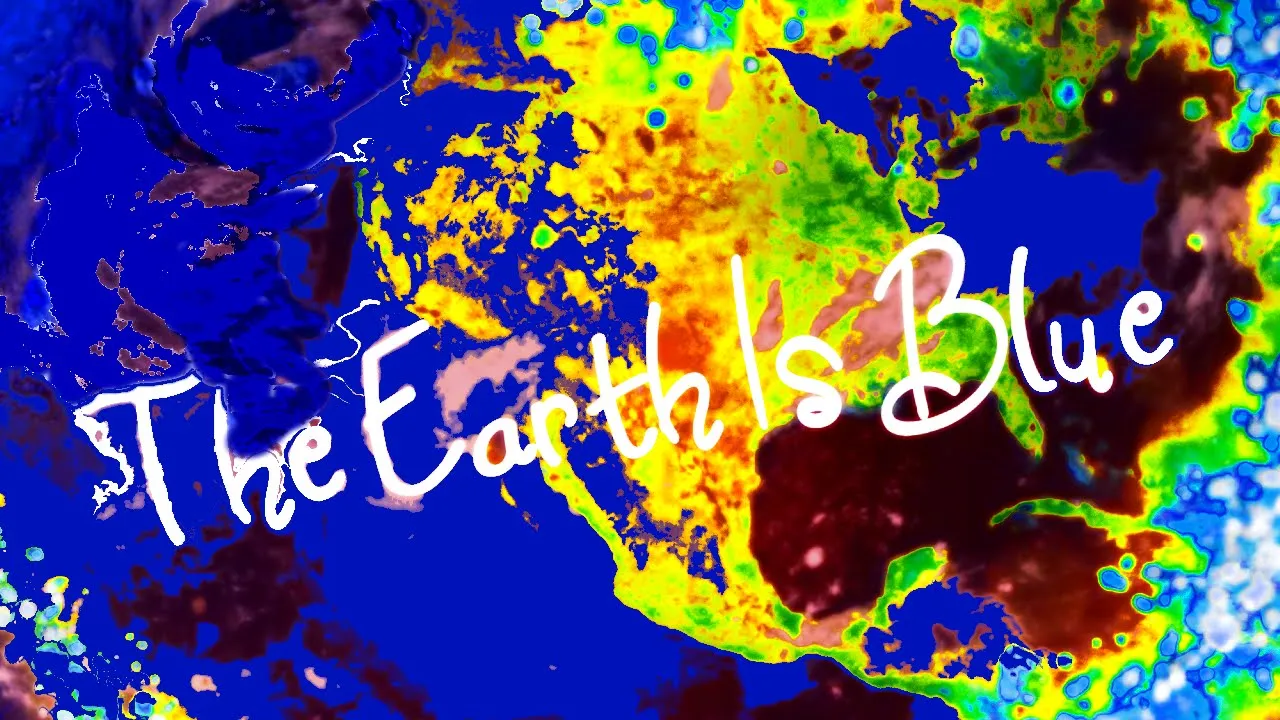
Angie Kuske: The Earth is Blue | Song Review
Kate Stanton explores the music and story of British singer-songwriter Angie Kuske, tracing how dreams, loss, collaboration, and a lifelong need to write shaped “The Earth Is Blue.”
Kate Stanton explores the music and story of British singer-songwriter Angie Kuske, tracing how dreams, loss, collaboration, and a lifelong need to write shaped “The Earth Is Blue.”
There is something immediately likeable about independent British
singer-songwriter and producer Angie Kuske. “Kuske rhymes with Husky,”
according to her social media, which feels like exactly the sort of
small detail Angie would make charming.
Her signature sound is vibrant synth pop with nostalgic textures and
rhythms designed to get stuck in your head. She has a warm smile and
kind eyes, but what stands out even more is the way she carries that
warmth into the independent music community.
Angie is the kind of artist who doesn’t simply post her own music and
disappears. She listens. I see her name on playlists, among mutual indie
music friends, and in the comments beneath other artists’ songs. She
doesn’t just say she likes something. She often says what the music
meant to her.
That distinction matters.
Earlier this year, Angie shared with me on social media that she was
bullied as a child and still sometimes struggles with the effects of it,
even experiencing a bad dream related to those memories. What strikes me
is what she seems to have done with that experience. Rather than passing
the hurt along, she seems determined not to make other people feel the
way she once felt.
How does she give that inner voice somewhere to go?
Through song.
She shares other musicians’ music. She leaves thoughtful comments. She
encourages people. She seems genuinely interested not only in the music,
but in the people making it. There is generosity in the way she
participates in the independent music world.
I found Angie’s music after she left a kind comment on one of my own
songs. We ended up having a short conversation about our mutual love of
Kate Bush, and I walked away from it feeling energized.
Perhaps that shouldn’t surprise me.
Angie’s own musical journey began with something she couldn’t quite give
a voice to yet.
The Words Were Already There
Angie started writing lyrics in the early 1990s.
But she wasn’t a musician in the traditional sense. She didn’t have the
training or technology to build songs around the words arriving in her
head, so she depended on finding composers who could take those lyrics
and turn them into music. Sometimes it worked. Sometimes it didn’t.
The difficult part, she says, was finding someone who shared her musical
vision and tastes. Eventually, songwriting took a back seat to work and
life.
But the words never completely left.
Every so often, a line would appear and she would write it down. The
songwriter was still there.
Then something unexpected happened. A Tarot card reader told Angie that
her words would one day be heard by thousands of people and that her
future was connected to something from her childhood. She immediately
thought of writing. She had always loved the English language at school
and had even written a short story when she was young.
This makes me think that some part of her already knew the writing had
never really gone away.
Author Steven Pressfield talks about something similar in The War of
Art. He calls the force that stands between a person and the work they
are meant to do “Resistance.” His argument is that Resistance tends to
become strongest around the things that matter most to us.
Angie’s story feels less like a battle against that Resistance than a
story about continuing to move toward the work anyway. She kept writing
when she could. She learned new skills when the opportunity came. She
found a way forward.
Years later, Apple’s GarageBand changed what was possible for her.
Suddenly, Angie didn’t have to wait for someone else to give her words a
musical home. She could begin doing it herself.
That feels like an important part of her story.
She wasn’t suddenly discovering that she wanted to write songs. She had
been writing them for decades. She was discovering that she could
finally give her inner voice somewhere to go.
She taught herself GarageBand, working with the software and a condenser
microphone. Once the main melody was in place, she began experimenting
with the sounds around it. Stereo panning and widening became particular
favorites.
She listened closely to other people’s music, noticing production
techniques and storing ideas away. She even tried mixing and mastering
her own tracks before realizing that collaboration could make the music
stronger.
Her recent work, including “The Earth Is Blue,” was mixed and mastered
by nON sTOP eROTIC cABARET.
There is something fitting about that.
Making music doesn’t have to mean doing everything alone. Sometimes
creating something personal also means knowing when to invite someone
else in.
When Words Meet Other People
Collaboration has become another chapter in Angie’s story.
Swedish musician Staffan Öfwerman, who played and toured with Roxette,
found her through Songwriter Link and asked her to write lyrics for his
song ideas. He gave her titles. She gave them words.
Three of her lyrics eventually appeared on his album Lost and Found.
Their first released collaboration began as a track Staffan had called
“Shirley Is In a Play.” Angie renamed it “Shelley.” She calls it
insanely catchy.
She’s right. But the collaboration story doesn’t end there.
Her latest release, “Suffocating,” is another example of Angie’s words
finding a new musical home. Ataraxia Music produced the rock track using
Angie’s vocals and lyrics.
It feels like a natural continuation of a journey that began decades
ago.
The words begin with Angie. Someone else hears them. A producer adds a
sound. A melody takes shape. Something that began as an idea inside one
person becomes something shared. We see this with her songs “Sleepy
Town” and “Wackadoodle” with Indiana-based producer and alternative rock
musician She Loves 2 Shop. She’s also collaborated with UK-based melodic
prog rocker Astral Rock on songs “Goodbye Time” and “The Earth Moon &
Sky”.
That pattern runs through so much of her musical life. Words meet music.
Music meets another person. And the possibilities keep expanding.
At the center of it all is still something remarkably simple. A thought,
a line, a melody. The possibility that something arriving unexpectedly
might become a song.
The Earth Is Blue
Maybe that is why “The Earth Is Blue” feels like such an important song
for understanding Angie.
It began with a dream.
In the dream, she was told she was dying.
That sounds frightening.
But the dream itself wasn’t.
Instead, Angie experienced an afterlife filled with beauty, love, light,
and the sensation of flying. She saw the Earth from somewhere beyond it,
surrounded by stars.
The dream lingered far less on death than on what came after.
When she woke, she didn’t wake with a song about fear.
She woke with hope.
And she wrote the lyrics immediately.
The Earth is blue from way out here
I watched it through my haze of tears
The future’s not entirely clear
But love will guide us on
And we all shine on
The song takes something most of us instinctively fear and turns it
toward wonder. Death becomes a journey. Goodbye becomes connection. The
unknown becomes something illuminated by love.
Angie describes the song as a positive, uplifting reflection on the
afterlife. She believes that when we leave this world, we will be
surrounded by love and light, with the people we have lost waiting to
welcome us home.
She has heard stories of near-death experiences that describe beauty and
love, and she chooses to believe that is where we are headed.
That belief gives the song its emotional center.
Yet Angie didn’t set out to write a philosophical statement.
She had a strange dream. She experienced something beautiful inside it.
She followed the feeling.
That may be one of the most revealing things about her songwriting.
Her songs often begin with her own experiences. She knows what
unconditional love feels like because she was fortunate enough to have
wonderful parents who gave it to her. Their love, she says, continues to
shine even though they are no longer here.
That experience of love and loss runs through her work.
“The Missing” and “Waves” explore grief after losing someone. “The
Candle” was written for her little black cat, Millie.
And love isn’t always uncomplicated.
Angie knows what it feels like to love someone who isn’t right for you,
and that experience has found its way into songs such as “Old Photo,” “A
Better Girl,” “Hard Work Man,” and “Drive Away.”
Then there is “Suck It Up,” her Taylor Swift-style breakup song.
Love comes in many forms, and Angie seems interested in all of them. Not
necessarily as a simple answer, but as something worth examining. I find
this particularly fascinating as I also believe love comes in many
forms.
In “The Earth Is Blue,” love becomes the thing that remains when
everything else is uncertain.
Those we’ve lost along the years
Are always with us now it’s clear
We’re waiting for you, have no fear
Our love will bring you home
There is comfort in those lines.
But there is also movement.
The song doesn’t stay in grief. It moves outward, through the stars,
toward light, toward reunion, toward home.
Angie hopes the song can help people feel less afraid of what is coming.
Whether someone shares her belief about the afterlife or simply hears
the song as a meditation on love and loss, the invitation is the same.
Don’t let fear be the only thing we imagine when we think about the end.
Imagine love. Imagine light. Imagine the people who mattered to you
still mattering.
And at the center of it is that beautiful image.
The Earth is blue.
Seen from far enough away, the world becomes something small and
luminous. I’m reminded of Kate Bush’s “Hello Earth” in Angie’s unique
style. The narrator is separated from it, but not disconnected. She
carries the people she loves with her.
The physical distance changes.
The love doesn’t.
Perhaps that is why the song feels less like a song about death than a
song about what gives life meaning.
Finding the Sound
Angie’s musical influences are not quite as straightforward as the
comparisons might suggest.
People have told her they hear an ’80s influence in her music, though
that wasn’t necessarily intentional. GarageBand’s limited selection of
rock and melodic electric guitars simply led her toward synth sounds.
When I approached her with questions for this article, I also brought up
the ‘80s influence. I learned that she offers so much more!
Her actual inspirations are broader. Melodic pop. Rock and pop. A great
beat. A melody that sticks in your head and makes you want to sing
along. Her favorite era was actually early 1970s glam rock.
She is drawn to great lyrics and songs that tell a story. For Angie, a
memorable song needs a strong hook and melody.
That helps explain the comparisons people have made to Kate Bush,
Blondie, and Kirsty MacColl. She considers each one a compliment. Kate
Bush for being artistic, inspirational, and unique. Blondie for those
uptempo songs and pounding beats. Kirsty MacColl because someone once
compared her voice to hers.
Angie isn’t especially drawn to ballads. She likes movement. She likes
melody. She likes a song that gets into your head.
But underneath all of that is still the lyric.
The story.
The feeling.
The image.
That is what seems to matter most.
Taking something internal and making it shareable. A feeling becomes a
lyric. The lyrics become a melody. A melody becomes a song. And a song
becomes a place where someone else might recognize their own experience.
The Voice That Stayed
The quiet thread running through Angie’s entire musical journey is that
the words were always there.
She began writing in the 1990s. Life interrupted. The words waited.
A Tarot reading reminded her that writing had always been part of who
she was. Technology eventually gave her a way to make music without
having to wait for someone else to understand exactly what she heard in
her head.
Then came collaboration. Other musicians. Other voices. Other
possibilities.
But the source remained the same.
The inner voice.
The sudden lyric.
The idea that appears in the middle of a sleepless night and refuses to
leave.
Some of those songs, Angie says, are often her best. One of them, “And
That’s That,” arrived with both lyrics and melody during a sleepless
night. The idea felt so immediate that she was convinced she must have
heard it somewhere before.
That instant feeling is part of what still excites her about
songwriting. A really good line. A melody. The possibility of turning
those first few pieces into something complete.
She describes being able to make music as a real gift, especially
because she never had formal musical training and never imagined she
would one day create her own songs.
And there is another kind of excitement, too.
Someone new wanting to collaborate.
That is how “Suffocating” came about with Ataraxia Music.
The creative process keeps opening another door.
Maybe that is also what makes Angie so generous with other independent
musicians. She knows what it means to have something inside you that
wants to be heard.
So she listens. She encourages. She connects. She makes room.
Sometimes an artist isn’t trying to become someone else. Sometimes they
are simply finding a way to let the person who has been inside them all
along finally be heard.
For Angie Kuske, that voice was there long before the music.
The words were already there.
She just needed somewhere to put them.
And perhaps that is what “The Earth Is Blue” ultimately gives us. A
reminder that something can begin inside one person and travel much
farther than they ever expected.
A dream can become a lyric. A lyric can become a song. A song can become
a memory for someone else.
And somewhere along the way, the private becomes shared.
In the words of Angie Kuske
And we all… shine on.
But love will guide us on.
Thank you, nON sTOP eROTIC cABARET.
Thank you, Ataraxia Music, She Loves 2 Shop, and Astral Rock!
Thank you, Angie Kuske!
Until next time, creators, follow your bliss.
Listen
Connect with Angie Kuske